My Three Words for 2017

I’ve never really been a fan of New Year’s resolutions; well-steeped in the world of strategy and planning, I’m more of a goals/objectives kind of person.  As I’ve gotten older (officially now that I carry that AARP card in my wallet), I’ve leaned more toward defining yearly strategies; I’ve come to realize that my life is a lot more about the direction I’m headed and the velocity with which I’m moving in that direction, rather than arriving at a particular destination.

But I recently came across Chris Brogan and his “three words” annual practice, where one identifies three words that represent areas of focus and intended accomplishment in the year ahead.  It’s grabbed me, probably because I’m now at that life stage where holding more than three thoughts in my mind simultaneously is too difficult.  My challenge has been reducing each idea to a single word (had to cheat to accomplish that), and finding words that apply equally to my personal life and professional practice (because keeping two separate word lists is definitely more than my brain can handle now).  Here are the three words I’ve selected for 2017:

Why.  (Short for find your “why” and live there.)  On the personal front, a number of life events in recent years have pushed me to re-examine my core purposes.  Once I thought I was rock-solid in that area, but upon reflection I realized that I don’t really “own” some of those purposes, I’m still lugging around a few purposes that merely attached to me from authority figures.  So, in a kind of delayed mid-life crisis — or perhaps more of a “I’m now at the age where I care much less about what others think of me and more about what I think of me” state — I’m out to re-discover and re-embrace my core “whys” of how I live life and pursue my calling.  Professionally, I’ve learned that it’s very challenging to differentiate yourself based on WHAT you do – especially if you’re in an “idea” business like innovation consulting.  The differentiator is WHY you do the WHAT (that is, your guiding purpose), and WHY you execute in the specific fashion that you employ (values, vision).  WHY is your differentiating perspective and approach that sets your organization apart from others.  In the trio of “what, why, how,” WHY is the driver of both “what” and “how.”  Clients discover you based on what you do, but they choose to do business with you based on WHY you do it your particular way.  Being clear on WHY, and relentlessly focused on staying true to it, is essential in both professional and personal life.

Simplematize.  (My cheat, as I made up that word – short for simplify and systemize.)  The world, and life, is increasingly more complex and complicated.  The velocity of change is accelerating dramatically.  Technology has simplified some things and vastly complicated others.  Success is found in relentless pursuit of the fundamentals.  Simplify life and work to the core essence, and then adopt systems to make those fundamentals run as smoothly as possible, granting maximum odds for success.  Strive to make the non-enriching, but necessary, activities run on near-autopilot, saving precious time and attention for the areas that generate true value and satisfaction.

Celebrate.  (Short for celebrate what and who you love.)  After almost six decades on this planet, I’ve finally come to appreciate the necessity to celebrate the things – and the people – that I love.  This can be as important as celebrating my joy in my spouse and children, or as seemingly trivial as celebrating national pizza week because I truly love pizza.  Professionally, this means recognizing the successful work and accomplishments of my team, appreciating them as unique individuals, and building an organizational culture of recognition and celebration.

Can you identify your three core words/concepts for 2017?  And how they guide your practice of delivering technology services?  I’d love to hear your ideas.


Michael Dieckmann is Chief IT Strategist for the University of West Florida’s Innovation Institute, where he leads the Institute’s IT Strategy Lab.  He also serves as the Chief Technology Officer for the Florida Virtual Campus.
The ETGers are here. Are you ready?

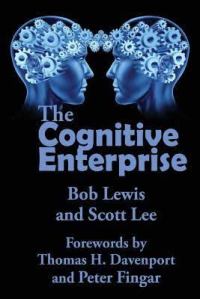
cogentI must confess that I like Bob Lewis.  Quirky, curmudgeonly, always writing with a heavy dose of cynicism toward the established management order. Nevertheless, he has the uncanny ability to always strike pay dirt when he digs, both in his previous books such as Keep the Joint Running: A Manifesto for 21st Century Information Technology and Leading IT: Still the Toughest Job in the World; as well as in his IS Survivor blog.  So I was not surprised to see that Lewis’ latest book with Scott Lee, The Cognitive Enterprise, also serves up a rich entree of insight, heavily seasoned with practical advice and wrapped in a light flaky wrapper of wit.

Lewis and Lee range far in this slim 210-page text before arriving at perhaps their largest insight, that “the way forward is a slippery slope.”  They begin by exposing the falsehoods behind the old “people, process, and technology” view of systems and organizations.  (A model that fails to include customers, by the way.)  In fact, in modern corporations since industrialization this formula has always in practice meant “PROCESS, technology, people” with people the mere agents/servants of the controlling process model and technology of the enterprise.  But what today’s organization needs is “to have all the brains in the enterprise actively engaged in the effort of advancing the mission,” because businesses are fundamentally assemblages of relationships.  Thus, Lewis and Lee call for today’s organization to be a cognitive enterprise – “one that behaves as if it had its own intelligence and purpose … one that acts more like an organism, one where business decisions are about the success of the business in its environment.”

Before describing how to create, staff, operate, and lead a cognitive enterprise, the authors first review several “canaries in the coal mine” – warning signs that the old organizational paradigm is dead.  One such canary is the dramatic shrinking in what they call the “stay-the-same to change ratio” – the rate at which accelerating change is confronting organizations and their environments, as compared to the previous stability that enabled mostly constant business models and long-range planning.  This shrinking stability is largely due to the forces of digital disruption.  Another canary is the dominance of the group that now makes up the majority slice of the workforce – commonly called the millennials, but labelled by Lewis as the “ETGers” – the Embedded Technology Generation.  Often called the Digital Natives, the Embedded Technology Generation members are “the first true cyborgs” – persons for whom technology permeates their lives, who live in a merged virtual/physical reality where the line between the two realms is increasingly blurry.  Creating products and services for the ETGers, and creating workplaces where they thrive and are productive, are major concerns for today’s and tomorrow’s enterprises.

Lewis’ and Lee’s antidote to this malady is a new enterprise model based not on the process-technology-people paradigm, but rather on customers, communities, and capabilities.  A requisite for this model is an environment where the organization “knows” what its workforce knows; that is, where knowledge is shared widely throughout the enterprise.  One where organizational culture and the shared knowledge on which it’s built are the true enduring infrastructure investments of the business.

The authors go both wide and deep in their robust exploration of the cognitive enterprise concept.  This is not another management “seven rules of” fad; much of it fits seamlessly with similar thinking on agility and adaptability, such as that found in General Stanley McChrystal’s Team of Teams; New Rules of Engagement for a Complex World.  The implications for the digital enterprise are profound, and IT leaders are among those who owe this book careful consideration.  Don’t worry: on a heady intellectual journey with Lewis, there are always tasty snack stands along the way.  A sampling includes:

  • The plural of anecdote is not data.
  • Permeability is the new normal.
  • This isn’t a problem.  It’s a constraint, the difference being that people can solve problems.  All they can do with constraints is understand them and deal with them.
  • ETGers don’t separate their personal and professional lives.  It’s all just life.
  • If you can’t model, you can’t manage.
  • Experience, someone once explained, is just-too-late learning.

You may decide not to pursue a cognitive enterprise.  (More’s the pity; come back in five years and let me know how you’re doing.)  But you should at least understand what one looks like, and how it might differ from what you’re doing today.  The business you save may be your own.


Michael Dieckmann is the Chief IT Strategist at the University of West Florida Innovation Institute, where he leads the IT Strategy Lab and serves as chief technology officer for the Florida Virtual Campus.

Book Review – The New IT: How Technology Leaders are Enabling Business Strategy in the Digital Age

Jill Dyche’s latest book – The New IT: How Technology Leaders are Enabling Business Strategy in the Digital Age – is a definite must-read for any IT leader attempting to transform her organization into a strategic asset for the enterprise.  What’s unique about The New IT is that it begins with mindset – your mindset if you are the CIO or IT leader – and it probes you to answer a key question: Who do I want to be in order to drive value?  The framework that Jill provides for you to examine that question, and her model for how you take action once you know the answer, are the two conceptual jewels in this book.

Ms. Dyche presents a structure of IT organization archetypes that are the foundation for resolving the IT leader’s identity crisis.  These representative profiles of the basic value models for an IT organization allow a CIO to examine both the current state of the IT organization (and by relation, the state of the CIO on the executive team) as well as identify a desired target state for the IT function.  Then, armed with this self-knowledge, the reader can use the IT transformation toolkit to maximize performance in the desired value-delivery model.

Readers must encounter books at “the right moment” in order for a book to have maximum impact.  For me, I certainly encountered The New IT at one of those “right moments,” when I find myself (once again) leading an IT organization through transformation on the road to maturity.  Ms. Dyche’s straightforward approach, based on decades of experience and research, provided the clarity I needed to quickly frame my organization’s problem as well as the path forward.  If you are an IT leader seeking to maximize the performance of your team, its value to the business, and your influence with the executive team, then this is probably the right moment for you to sample The New IT as well.

Tagged , ,